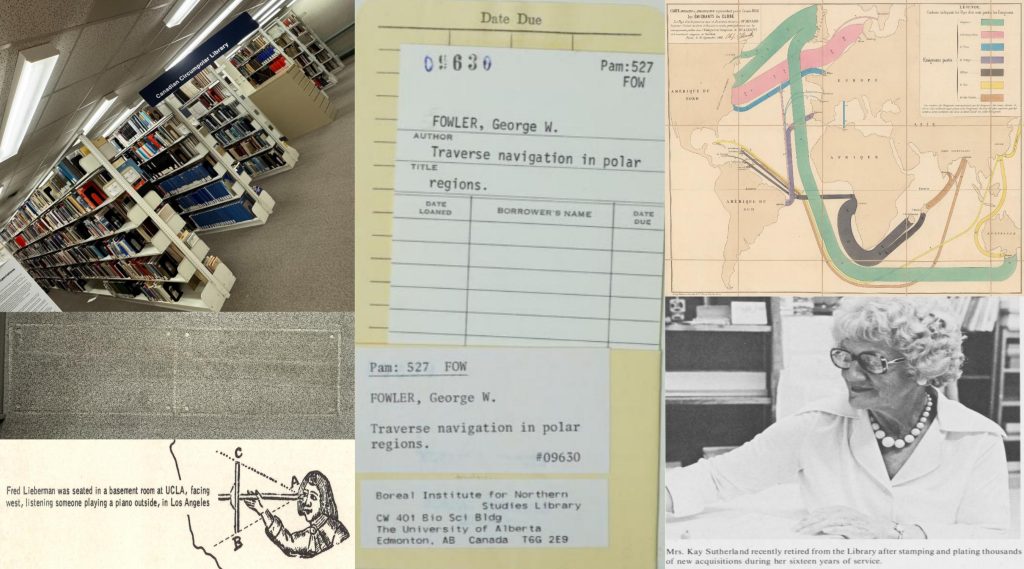
October 15th, 2025 was the 60 year anniversary of A fluxatlas : Spatial Poem, by Mieko Shiomi. To construct the map, Mieko Shiomi contacted people around the world (many who were part of “Fluxus” an international community of artists) asking individuals to record what they were doing & the direction they were facing the morning of Oct 15, 1965. Wanting to celebrate, I walked out of the map room on the 4th floor of Cameron library, rotated South-East, and snapped a picture of the Canadian Circumpolar Collection,1 while in ponderance of the impending move.
I have always been fascinated by the physical footprint of collections. The strong steady appearance of steely shelves and their voluminous heft suggest a confiuration that has always been. Yet, collection stances are tenuous. Continually moving, interfiling, weeding, and eventually shifted to that ”locker in the transom” offsite storage.2
Except for library/collection names, addresses on old checkout slip pockets, and stamps and/or bookplates in the physical monographs there is no easy way to reconstruct past institutional collection locations. When a collection is disassembled its location code is overwritten. In other cases, especially if the items were acquired as a donation, a local note is added to the record. A recent example, the materials from the Faculty of Native Studies Strynadka/Brady Reading Room.
While I am sure there are technical/labour intensive reasons for the deletion of former location codes, their expunging seems detrimental to future researchers. Imagine a Minard-like flow diagram (a spatial mono-cem-trail) from building to building with arrows showing the direction of collection moves and a line thickness related to the volume of materials.
With this in mind, a shelflist snap-shot was taken of the Canadian Circumpolar Collection a few weeks ago, capturing the collection’s last stance. This spreadsheet scaffolding will provide future researchers with a path to investigate the collection.3 A simple example, sorting by Library of Congress call numbers (thematic, geographic and a gutter of cutters) as a way to reconstruct clusters of related materials. Or the possibilities of scripting crosswalks that shift Library of Congress call numbers to other classifications schemes like the Brian Deer Classification System (BDCS), or the Scott Polar Research Institute’s Universal Decimal Classification system that was adapted for polar libraries. Going forward, one can hope that shelf list snap-shots are done for other physical collections on the cusp of moving and melding as libraries substitute physical holdings for ongoing student study/social space and internal and external staff office space.
All of this makes me appreciate the digitization of the Circumpolar Pamphlets Collection (a variety of government, institutional and Indigenous community reports) that now reside on the Internet Archive as its own unique collection. Not only do these 3000 items have enormous research value, they are now virtually locked and located together including notes that the material was originally part of the Boreal Institute for Northern Studies Library (1960s – 1980s), before the name change in the 1990s to the Canadian Circumpolar Institute when the collection was transferred to the University of Alberta Library. Just last week the pamphlets and their vertical containers left Cameron Library. All that remains are the imprints on the carpet.
- To trace the history of the Canadian Circumpolar Collection see:
Circumpolar Digital Image Collection, Colloquy on Northern Library Resources, Canadian Circumpolar Institute ↩︎ - Melville, Herman. (1851). MOBY DICK or, THE WHALE.. CHAPTER 44. The Chart. Project Gutenberg ebook 2701. ↩︎
- For example the most checked out item is Madenwald, Abbie Morgan. (1992). Arctic schoolteacher : Kulukak, Alaska, 1931-1933. University of Oklahoma Press. Earliest acquisition recorded in 1980. Alberta Oil Sands Environmental Research Program. (1979), Proposed design for a program of toxicological research for the Alberta Oil Sands Environmental Research Program .no.0041. ↩︎